


On the morning of Monday, May 18, about 140 children were inside the Islamic Center of San Diego for school. By noon that day, three people were dead outside.
At around 11: 43 a.m., San Diego police received reports of an active shooter at the center located in the city’s Clairemont neighborhood. Officers arrived within four minutes and found three adults dead outside the building. A wave of grief followed that day and a realization that something in America has shifted.

The two gunmen, identified as 17-year-old Cain Lee Clark and 18-year-old Caleb Liam Vazquez, shot and killed a security guard and two other community members outside the mosque before fleeing. Both were later found dead from apparent self-inflicted gunshot wounds.
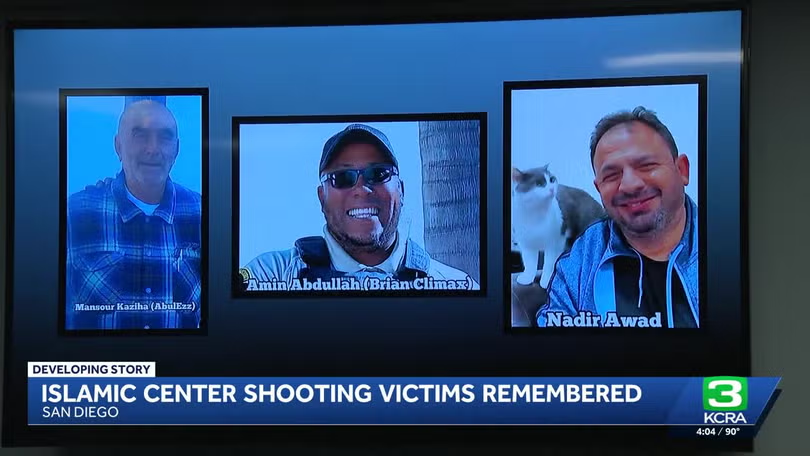
The three victims were Amin Abdullah (security guard at the mosque), Mansour Kaziha (a long-time staff member) and Nader Awad (a member of the community). Before he was killed, Abdullah managed to activate the building’s lockdown protocol. This decision was one that most likely saved the lives of the children inside.

“It really saddens me that there is all of this hate going around all over the country,” junior Sophia Rasteger said.
Investigators found that a racist manifesto was apparently written by the suspects that referenced the 2019 Christchurch mosque shootings in New Zealand. Authorities are treating the attack as a hate crime. Anti-Islamic writings were also recovered and the words “hate speech” were on one of the firearms.
What makes this attack stand out, even beyond its tragic outcome, is how unprecedented it is. The Center for Strategic and International Studies has tracked dozens of attacks and plots targeting U.S. mosques since 1994. However, not one had ever had a fatality until now. Usually, the plots were stopped. Arson had been set against empty buildings in the middle of the night. But a lethal, ideologically motivated attack at a mosque? That had never happened in a while until San Diego.

“This attack really surprised me and really upsets me because of all the antisemitism seen since Oct. 7, and now this attack just shows that people will keep hating on each other,” freshman Michal Gavriel said. “I really hope the world can move towards peace instead of this constant hatred toward one another.”
This story hits closer to home than it might seem. Many students at North High go to school every day alongside classmates of Muslim faith. The mosque that was attacked also houses a K-12 school on its campus, meaning the people inside that building on May 18 were not kids different from us. They were sitting in class, going about their regular Monday.
“This situation left me unsettled because I realize this could happen anywhere, and it is not okay,” junior Emily Livian said. “Students should be able to go to school and live their normal lives without fear of shooters simply due to their faith.”
Security experts say the attack will likely change the way mosques across the country think about safety. Ironically, faith leaders were in Washington that very day asking for increased federal funding to protect religious institutions when news of the shooting broke out. The question of how to make religious sites safer without making them feel like fortresses has become more and more urgent.
There are small things students can do: learn about Islamophobia, check in on Muslim classmates and think about how this hate starts. Hate like this starts small and then grows into violence. Whether it’s young kids bullying or a shooter, this hatred is prevalent. The victims of May 18 were a security guard doing his job, a staff member who had given years to his community and a neighbor who simply belonged there. They deserved an ordinary Monday.


