This year, Black Friday felt more like a routine sale rather than the blockbuster bargain event many of us recall. Even though national spending totals reached new highs, the specific deals themselves told a different and far less impressive story. Across categories, many discounts were shallow, repetitive or simply misleading, leaving shoppers questioning whether Black Friday is still worth the hype.
According to WalletHub, 36% of products advertised as Black Friday deals in 2025 offered no actual savings compared with their prices earlier in November. Also, 9.5% were more expensive on Black Friday than they had been weeks before. While retailers continued to promote bold, eye-catching graphics promising big markdowns, there was barely any substance behind those promises.
“I honestly still used Black Friday to buy a bunch of stuff because it’s cheaper than normal, but the sales weren’t as good as they should have been, especially for such an established holiday,” freshman Michal Gavriel said.

Meanwhile, overall online spending surged. According to Adobe Analytics, U.S. consumers spent $11.8 billion online on Black Friday, which was a 9.1% jump from 2024. However, these soaring values can be deceiving because higher spending does not really mean better deals. Inflation, rising product costs and shoppers buying more items at near-regular prices can all push totals upward without giving meaningful consumer savings.
Part of the disappointment stemmed from retailers’ reliance on “Up to” advertising. This advertisement method often inflates expectations without offering large price cuts. Only a small minority of items ever reach the advertised maximum discount, while many others remain barely below their regular price. Combined with the use of artificially raised “original” prices, the result is a sale that looks dramatic at first glance but provides little genuine value once shoppers go deeper. For instance, some stores flash “Black Friday 80% off”, but in small print will include “up to,” making consumers feel so excited that they overlook the fact that a very small amount of the actual items will be 80% off.

A decade ago, Black Friday was synonymous with dramatic price slashes, televisions half-off, laptops hundreds of dollars off and true “doorbusters” that justified the early morning lines. Today, those headline-making steals have largely faded. Although spending levels exceed those of pre-2020 seasons, the discounts themselves often lack the depth that once made Black Friday feel special.
“Some of my favorite stores barely made it past 50% off for Black Friday sales, and if it did, it was always up to this much percent,” junior Eden Roosenberg said. “I remember years ago people used to go crazy for these sales but now it’s just not that good anymore.”
While some categories, such as apparel and certain home goods, offered respectable savings, electronics, popular tech gadgets and clothing stores were noticeably lacking in the huge sales. Many high-interest items simply didn’t change in price. For students hoping to score new headphones, a gaming system or a laptop, the bargains often felt more like standard weekly sales than holiday exclusives.
“I really wanted to get a new laptop for Black Friday but the sales weren’t even helpful because I wanted to take this opportunity to save money on an expensive item,” junior Elan Harel said.
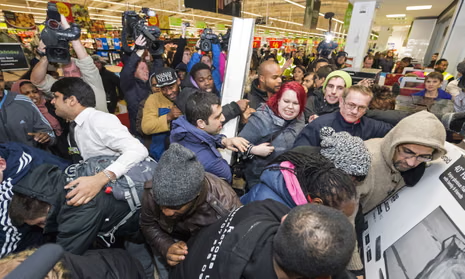
Years ago, Black Friday sales often led to fist fights and arguments in stores over high-marked-down sale items. Now, this isn’t seen as much due to the decrease in sales qualities.
So, what does all this mean for the future of Black Friday? The day clearly isn’t disappearing, but its identity is shifting. Instead of being a once-a-year opportunity for extraordinary discounts, it increasingly resembles a typical seasonal promotion with dramatic marketing. With price comparison tools and inflation-driven caution shaping student budgets, Black Friday may now require a more strategic approach.
Today’s consumers, especially high school students trying to stretch their dollars, should think of Black Friday not as a guaranteed jackpot, but as one option among many. Checking price history, comparing retailers and questioning flashy discount labels can make the difference between snagging a real deal and falling for a cleverly packaged “sale”.