On Jan. 3, 2026, the United States invaded Venezuela in a surprise overnight military operation authorized by President Donald Trump, resulting in the arrest and removal of Venezuelan President Nicolás Maduro and his wife. United States forces launched air and land military operations in Caracas, detaining Maduro and transporting him to the United States to face criminal charges.
The White House confirmed its plan to prosecute Maduro on charges including drug trafficking and corruption. Trump described the operation as “decisive and necessary,” arguing that Venezuela under Maduro had become a threat to regional stability and United States security. His justification for the major operation was that years of sanctions and diplomatic pressure had failed, and that military action was the only remaining option. The White House stated that the invasion was targeted at leadership removal rather than long-term occupation; however, American forces remain in the country to maintain stability.
“I think Trump did what had to be done to weaken Maduro’s regime,” junior Raphael Nassimiha said. “This operation is a positive step towards gaining freedom for the Venezuelan people.”
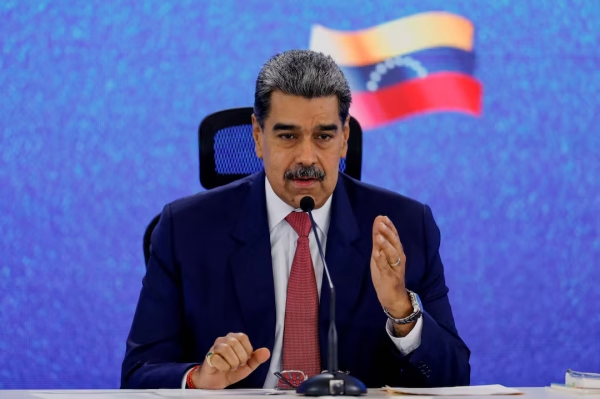
Maduro rose to power in 2013 following the death of Hugo Chávez and took on similar social policies. Under his rule, major problems such as hyperinflation and medicine shortages grew, forcing millions of Venezuelans to flee the country in one of the largest migration crises in the world.
As conditions worsened, Maduro’s government became more authoritarian. Elections were controlled to the point of being futile, opposition leaders were arrested or forced into exile, and the administration was accused of human rights abuses. The United States and several allies accused Maduro of running a corrupt and illegitimate regime, while Maduro insisted that foreign sanctions and United States interference were responsible for Venezuela’s collapse. This standoff intensified during Trump’s presidency, when the United States imposed sweeping sanctions on Venezuela’s oil industry and recognized opposition leader Juan Guaidó as the country’s rightful president in 2019.
Despite years of economic instability and internal unpopularity, Maduro remained in power, backed by support from countries such as Russia, China, and Cuba.

Reaction to the invasion has been divided. Some Venezuelans celebrated Maduro’s removal, hoping that the end of his rule could finally bring about political change and economic recovery. However, others fear that foreign military intervention would only deepen instability and result in civilian casualties.
Internationally, several governments condemned the invasion as a violation of international law and Venezuelan sovereignty, warning that it sets a dangerous precedent for international involvement in foreign affairs and governments. At the same time, some United States allies and opponents of Maduro’s regime argued that the act was justified after years of failed diplomacy and worsening human rights abuses.
“I think President Trump could be overstepping his role,” junior Chandra Lin said. “However, if this leads to the freedom of Venezuela, I think this could be good.”
In the United States, the invasion has fueled ongoing debates over presidential powers and America’s role in international affairs, sparked by many of Trump’s presidential decisions. Supporters of the invasion argue that removing Maduro protects the United States and instills fear in other authoritarian regimes. However, the invasion also undermines international political organizations and risks putting the United States in a situation where it does not belong.
A temporary governing arrangement led by United States Secretary of State Marco Rubio has been announced, and he has stated that it will support a transition towards new elections as Delcy Rodríguez, the former Venezuelan vice-president, acts as interim president. For many Venezuelans, however, daily concerns such as access to food, electricity, and medical care remain unchanged.

The invasion of Venezuela has significant implications for both countries. For the United States, it revives imperialistic politics in the western hemisphere, and for Venezuela, it is uncertain what this operation will bring. Whether the events of Jan. 3 lead to democracy or instability will depend on decisions made in the months ahead.